Local
Hurricane-Season Flooring Choices for Jacksonville Flood Zones

By Jimmie Wilson, owner of JW Painting & Pressure Washing & Epoxy Flooring
More than 30 years of hands-on painting and finishing experience
Published · Updated
- 5.0 on Google · 82 reviews
- Based in Jacksonville, FL 32254
- Where Precision Meets Perfection
Short answer
FEMA's Technical Bulletin 2 rates mortar-set ceramic and porcelain tile, terrazzo, poured epoxy and glue-down vinyl on concrete as flood damage-resistant. Carpet, laminate and wood flooring are rated unacceptable below flood level. In Jacksonville, look up your flood zone first, then pick a floor by how it handles three days underwater.
Every June, Jacksonville homeowners who need new floors face the same question: what happens to this floor if water comes in? The label on the box matters less than three other things. Where does the house sit, how long could water stay, and what is the floor stuck to? This guide covers the federal rules, where popular products fall, and how to time the work.
What does your flood zone actually tell you?
FEMA's flood maps sort land by the chance of flooding. A Special Flood Hazard Area is ground with a 1 percent chance of flooding in any given year, also called the base flood or 100-year flood. On the map those areas carry labels such as Zone A, AE, V and VE.
Shaded Zone X marks moderate risk, between the base flood and the 0.2 percent (500-year) flood. Unshaded Zone X is minimal risk. FEMA's Flood Map Service Center is the official place to look up the maps for any address.
A low-risk zone is not a promise. FEMA's Technical Bulletin 2 notes that up to 40 percent of flood insurance claims are paid on buildings outside the mapped high-risk areas. Big storms test the maps. During Hurricane Irma in 2017, the National Weather Service said surge flooding downtown beat the 1965 Hurricane Dora record by at least a foot. Clay County emergency managers put the record crest of Black Creek near Middleburg at about 28.5 feet.

Which floors does FEMA rate as flood damage-resistant?
FEMA defines a flood damage-resistant material as one that survives direct contact with floodwater for at least 72 hours, needing only cosmetic repair. Cleaning, sanitizing, sanding and regrouting count as cosmetic. Replacement does not.
Technical Bulletin 2, updated in January 2025, rates common finish floors this way:
| Floor finish | FEMA TB-2 rating | What decides it |
|---|---|---|
| Ceramic or porcelain tile, mortar set | Acceptable | Cement-based mortar holds when wet |
| Ceramic or porcelain tile, organic adhesive | Unacceptable | Mastic softens and lets go |
| Terrazzo | Acceptable | Solid cementitious or resin surface |
| Epoxy or polyurethane, formed in place | Acceptable | Poured coating bonded to concrete |
| Homogeneous vinyl sheet or tile, chemical-set adhesive | Acceptable | Only on a concrete floor |
| Carpet and linoleum | Unacceptable | Absorb water and trap it |
| Solid wood, engineered wood, plastic laminate | Unacceptable | Wood and paper cores swell |
The bulletin also warns that combinations matter. Glue-down vinyl that passes on concrete fails over plywood, because the vinyl must come up before the wood can dry. The same logic applies to any floor that seals a wet material underneath it.
Where does waterproof LVP fit?
This is the question most homeowners ask, and the honest answer is that it depends on the space. Floating rigid-core plank does not appear in FEMA's table. The plank itself shrugs off water, but floodwater runs under it through the seams and edges, and the slab beneath stays wet until the floor comes up.
FEMA allows unlisted materials below flood level if the local official accepts evidence that they survive with cosmetic repair. In March 2024, ASTM published two standards, E3075 and E3369, that give manufacturers a test path for exactly that question. Until a product shows that evidence, treat plank as a smart choice for living space above flood level, not as a code-rated flood floor.
Where plank does make sense, the install details carry most of the weight. Most floating floors call for a moisture barrier on concrete, often 6-mil polyethylene, plus a perimeter expansion gap. Our luxury vinyl plank flooring page explains how we test the slab and lay the barrier before the first row goes down.
When do flood rules apply to a flooring job?
For most homes in Duval County, replacing the floor by itself is finish work. Florida jurisdictions using the residential code's permit exemptions generally treat tile and carpet as permit-exempt, though the building official makes the call. Confirm with the local building department before you start.
The flood rules come in through the size of the whole project. FEMA calls work a substantial improvement when its cost reaches half the building's market value before the work starts. Substantial damage uses the same 50 percent line for the cost of repairing a building after any kind of damage. Either one brings the building under flood-zone construction rules, including flood damage-resistant materials below base flood elevation.
That means new floors after a storm can be part of a review, even when the floor itself needs no permit. If you are rebuilding after water got in, our water-damaged floor replacement page covers how we check the slab or subfloor before anything new goes down.
Outside the regulated zones, FEMA still recommends flood-resistant choices in flood-prone houses. The bulletin's own list includes swapping wood floorboards and carpet for tile, vinyl or rubber, and using throw rugs you can carry out.
How to time a floor replacement around hurricane season
The Atlantic hurricane season runs June 1 to November 30. The National Hurricane Center puts the peak on September 10, with most activity between mid-August and mid-October. A whole-house replacement can be planned around that, and the steps below keep the choice and the schedule in the right order.
- Look up the flood zone for the address on FEMA's Flood Map Service Center, and note whether the house sits in a Special Flood Hazard Area.
- Ask about the bigger project. If floors are one part of a larger remodel or storm repair, ask the building department whether it counts toward substantial improvement.
- Test the slab. We read relative humidity inside the concrete with in-situ probes under ASTM F2170 before choosing an adhesive, barrier or coating.
- Choose the assembly, not just the surface. Tile needs mortar and movement joints, plank needs a barrier, and an epoxy coating needs a ground, profiled slab.
- Book the work for the slower months. Late fall through spring keeps a long tear-out and install away from the peak of the season.
- Check your flood policy timing. FEMA says a new flood insurance policy typically has a 30-day waiting period. Do not wait for a forecast to buy one.
Trade-offs we see in the field on flood-prone floors
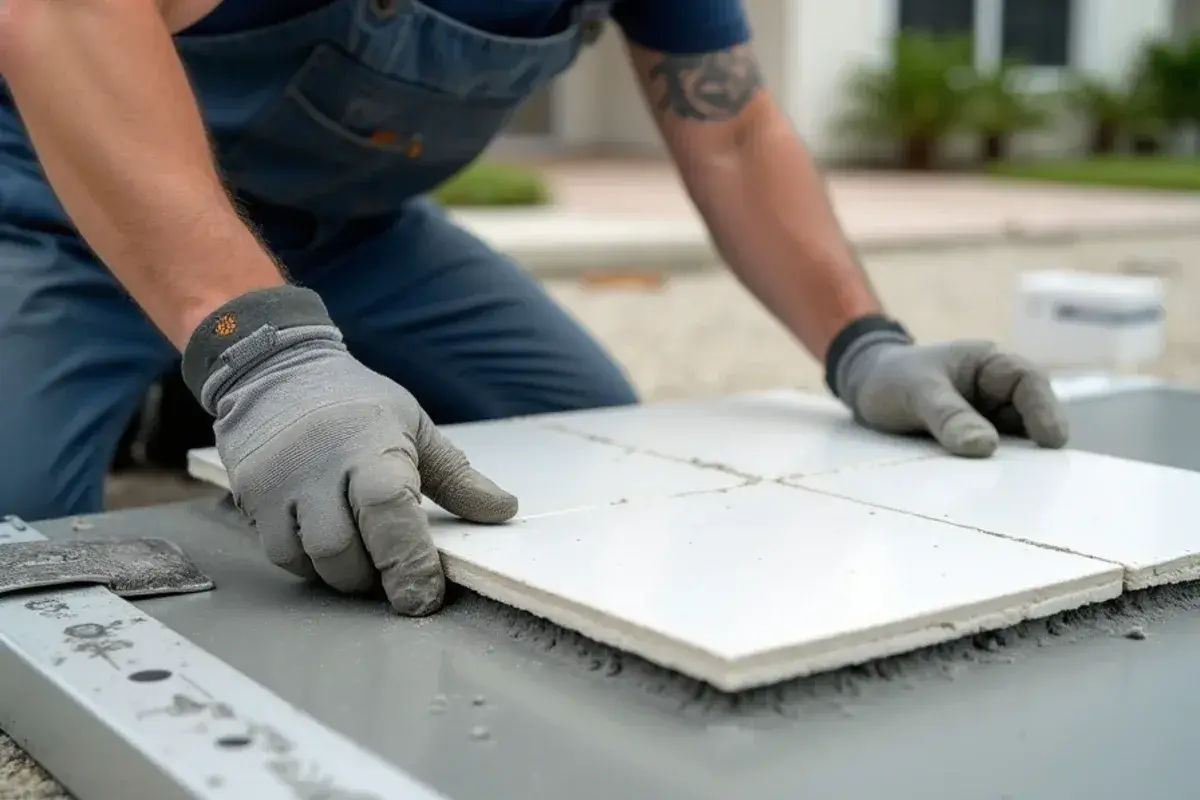
Tile is the classic answer, and it earns the reputation. FEMA has called ceramic tile set in thin-set mortar on a slab, with cementitious grout, a flood damage-resistant assembly. It can still de-bond, though, especially where the installer left out expansion joints. The TCNA Handbook's EJ171 method calls for joints at the perimeter and at changes of plane. Over a cracked slab, we add an uncoupling membrane.
Plank is the comfortable, budget-friendly choice, and it is often the right one for second floors and raised rooms. On a ground-floor slab in a low area, plan on it as a floor that may come up and go back down. A floating floor can be taken up so the slab dries. Whether the boards go back down depends on the maker's instructions and what was in the water. Floodwater from outside falls in the IICRC S500 standard's Category 3, the most contaminated class, so treat plank that sat in it as suspect.
Wood is where we push back. Engineered boards move less with humidity than solid wood, but FEMA still rates both as unacceptable below flood level. In Orange Park ranch homes on low riverfront streets that took on water during Irma, we steer clients toward tile or coated concrete downstairs. The same goes for houses near Doctors Lake. Wood goes in rooms higher up.
Coatings deserve a look, too. A poured epoxy floor bonded to a diamond-ground slab is on FEMA's acceptable list. It suits garages, laundry rooms and ground-level rec rooms that sit lower than the rest of the house.
Frequently asked questions
Is porcelain tile the most flood-resistant floor for a Jacksonville home?
Yes, among common household floors it is one of the safest picks, as long as it is set in cement-based mortar on a concrete slab. FEMA rates mortar-set tile acceptable and tile stuck down with organic mastic unacceptable. The weak spot is the bond, so we add perimeter movement joints and, over cracked slabs, an uncoupling membrane.
Does waterproof LVP count as flood damage-resistant under FEMA rules?
No, not automatically. Technical Bulletin 2 does not list floating rigid-core plank at all. It rates homogeneous vinyl glued to concrete with chemical-set adhesive as acceptable, and other vinyl uses as unacceptable. Unlisted products can be accepted by the local floodplain official with test evidence, so ask before you count on plank in a regulated space.
Do I need a permit to replace floors in a flood zone?
No, not usually for the floor alone. Finish flooring is generally exempt from building permits in Florida, but confirm with the local building department. The exception is a larger repair or remodel: if the total cost reaches half the building's market value, FEMA's substantial improvement rules apply and the whole project gets reviewed.
Should I wait until after hurricane season to replace my floors?
No, not if the current floor is failing or holding moisture. Waiting through a wet season can let mold or a rotting subfloor get worse. If the floor is just dated, though, scheduling a whole-house replacement for the cooler months after November 30 keeps the work clear of the busiest stretch of the season.
The bottom line
Start with the map, then match the floor to the water it might face. Mortar-set tile, terrazzo and poured epoxy hold up best below flood level, glue-down vinyl works on concrete, and wood, laminate and carpet belong higher in the house. Floating plank is a good floor, but not a code-rated flood floor, so use it where a lift-and-dry plan is acceptable.
If you are weighing floors for a house near the river, a creek or a low street, call (904) 533-7260. We measure, test the slab and put the options and the price in writing.
Related
Services and areas from this article
Talk to a Jacksonville floor crew
Questions about your own floor after reading this? Call (904) 533-7260 and describe what you're seeing.
JW Painting & Pressure Washing & Epoxy Flooring · Jacksonville, FL 32254 · (904) 533-7260
Mon–Sat 7am–8pm · Sun closed