Core service
Metallic Epoxy Floors for Living Spaces: Pros, Cons and Upkeep

By Jimmie Wilson, owner of JW Painting & Pressure Washing & Epoxy Flooring
More than 30 years of hands-on painting and finishing experience
Published · Updated
- 5.0 on Google · 82 reviews
- Based in Jacksonville, FL 32254
- Where Precision Meets Perfection
Short answer
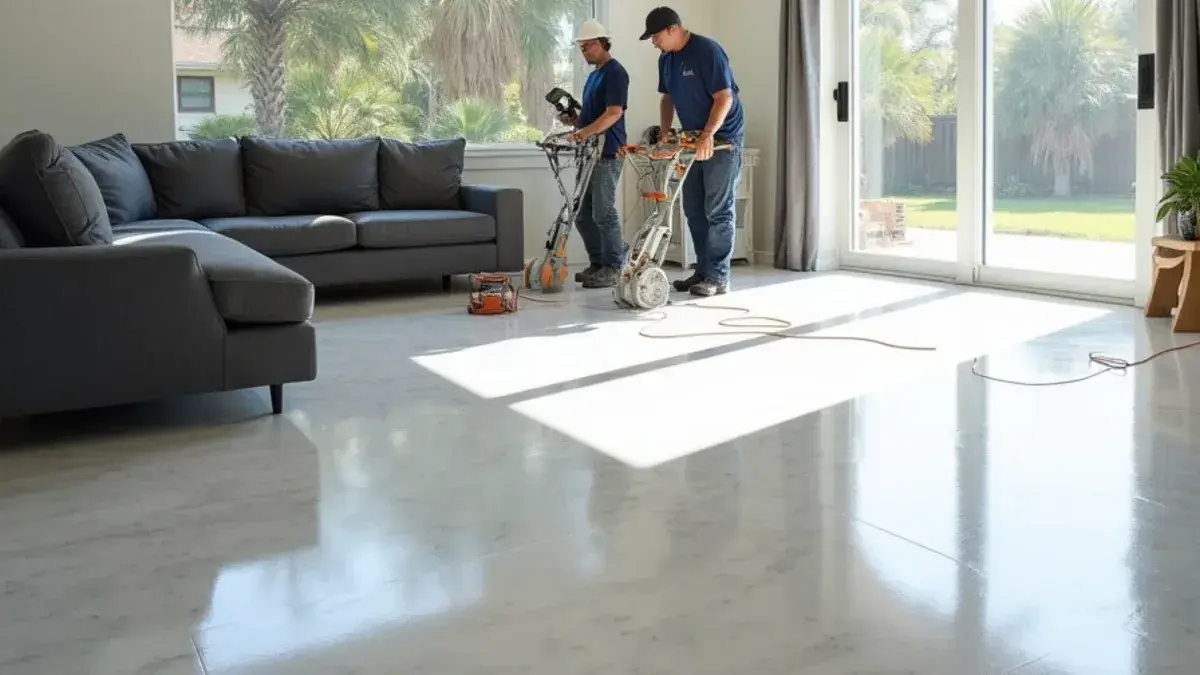
A metallic epoxy floor gives a living space a one-of-a-kind, glossy look on a concrete slab. The trade-offs are real: it shows scratches, standard epoxy yellows in sunlight without a UV-stable topcoat, and it fails fast on a poorly ground or damp slab. With good prep and simple care, it holds up well indoors.
A metallic floor is the kind people stop and photograph. The swirls and depth look like poured stone, and in a living room they can be striking. Before you commit, it helps to know where these floors shine, where they disappoint, and what they ask of you after the crew leaves.
What makes a metallic epoxy floor different?
A metallic system is an epoxy coating with metallic pigments mixed into the resin. While it is still wet, the installer works the material with rollers and tools, and the pigments settle into ripples, clouds and marbled veins. The effect reads as three-dimensional under light.
That hand-made pattern is the whole appeal, and also the catch. No two floors look the same, and the look depends heavily on the installer's skill. It also costs more than a plain or flake epoxy because of the extra labor and materials. Our epoxy flooring page compares metallic with flake, solid and quartz systems.
Pros and cons at a glance
| Pros | Cons |
|---|---|
| One-of-a-kind look; no grout lines or plank seams | Shows scratches and grit marks on the glossy surface |
| Hard, easy-to-sweep surface; no pet hair caught in fibers | Standard epoxy yellows in sunlight without a UV-stable topcoat |
| Bonds directly to the slab, so no height is added at doorways | Needs a properly ground, dry concrete slab; not for wood subfloors |
| Spills wipe up from the sealed surface | Slick when wet unless grit is added, which dulls the depth |
| Can be recoated to refresh the gloss | Spot repairs rarely blend into the pattern |
Will Florida sun turn a metallic floor yellow?
It can, if the wrong topcoat goes on. Most standard epoxies are aromatic resins, and UV light breaks down those structures into yellow-brown compounds. A coatings industry guide notes that even indirect sunlight through a window can start the process, and heat speeds it up. Epoxies also amber slowly with age, even out of the sun.
In a Florida living room with sliding doors, that matters. A white or silver metallic is the most likely to drift toward cream near the glass. The fix is a UV-stable clear topcoat, usually a polyurethane or polyaspartic aliphatic product, over the epoxy layers. Concrete Network recommends a clear polyaspartic topcoat for exactly that reason. Darker bronze, copper and charcoal tones tend to hide slight ambering better than whites.
Why do slab prep and moisture decide how long it lasts?
A metallic floor is only as good as its bond to the concrete. Concrete Network puts it bluntly: a high percentage of coating failures come from poor surface prep.
The surface needs texture. The concrete repair industry grades it on the ICRI concrete surface profile scale. Sherwin-Williams notes that acid etching only reaches about CSP-1 to CSP-2, while modern high-solids coatings need CSP-3 or more from diamond grinding or shot blasting. Acid also leaves water in the slab and cannot lift curing compounds or oil.
Moisture is the other half. Vapor rising through concrete carries alkaline salts to the bond line, and coating makers trace blisters and peeling to it. With Jacksonville averaging about 76% relative humidity, the slab gets tested, not eyeballed. New concrete needs time as well: Stonhard recommends at least 28 days of cure before coating, and longer in humid weather.
A well-built system goes down in this order:
- Moisture test the slab with ASTM F2170 probes or an F1869 kit.
- Diamond grind to the profile the coating maker specifies, then vacuum.
- Fill cracks, pits and joints so they do not telegraph through the gloss.
- Apply a primer, moisture-tolerant if the readings call for one.
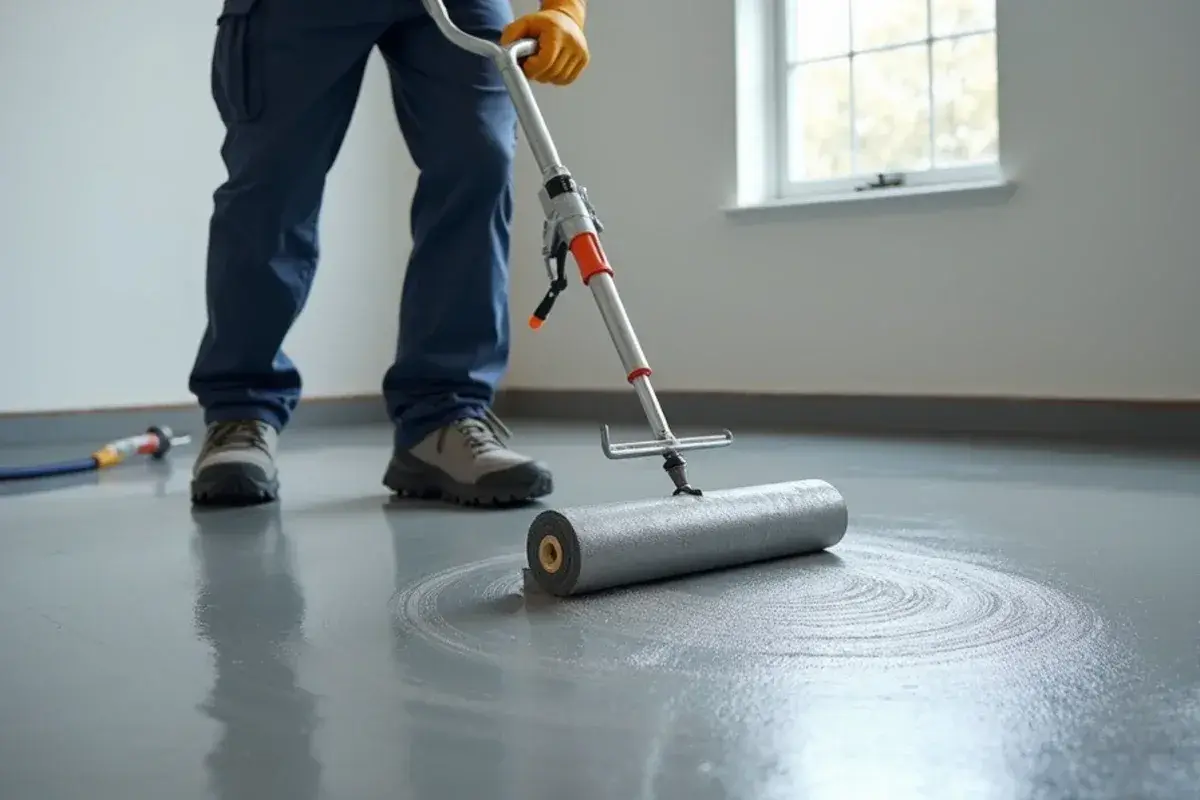
- Roll a tinted base coat, then the metallic coat, worked while wet.
- Finish with a UV-stable clear topcoat, adding grit where wet traffic is expected.
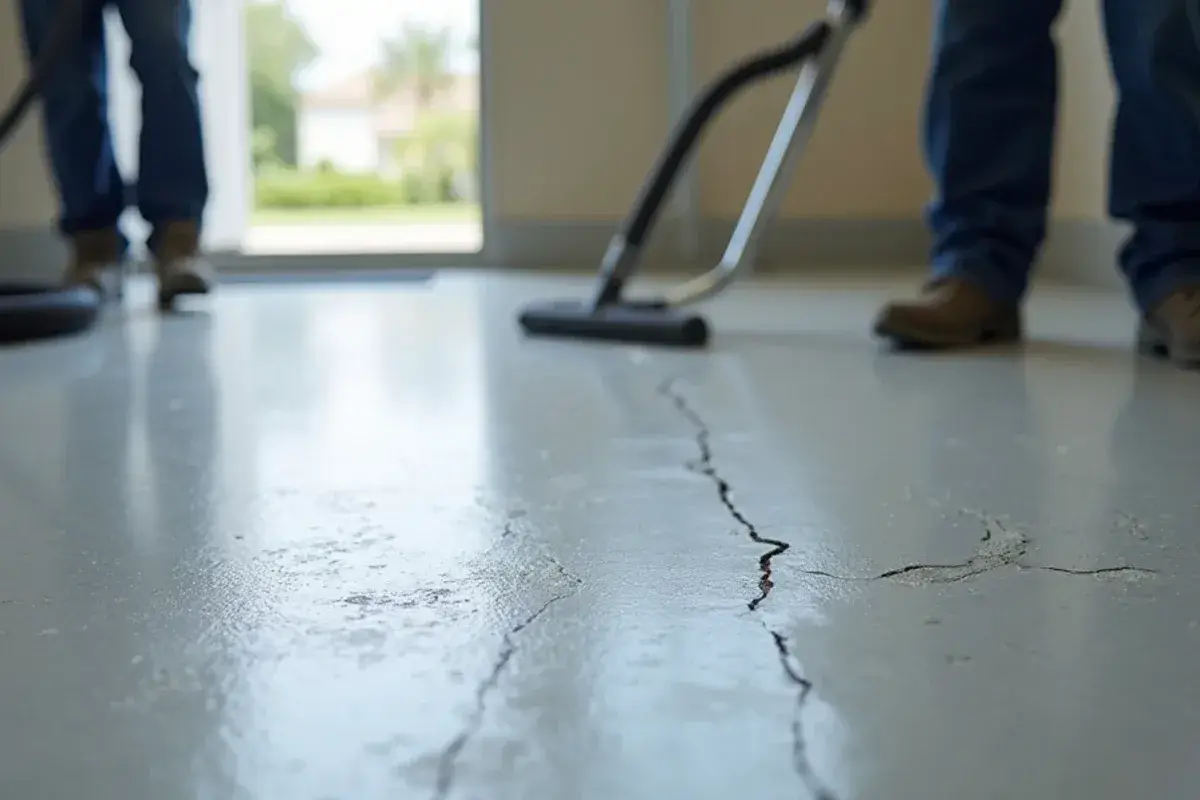
Prep matters even more under a metallic finish than under flake. A glossy, reflective surface acts like a mirror for whatever sits beneath it. Low spots, old trowel marks and filled cracks that a flake broadcast would hide can show as ripples in the light. That is why the grind and patch stage takes longer on these jobs, and why it pays to study the slab under a low, raking light before anyone quotes it.
How do you keep a metallic floor looking new?
Upkeep is simple, but the gloss rewards consistency. Grit is the enemy: sand tracked in on shoes acts like sandpaper under every step.
Checklist
- Put a good doormat at every outside door, and a rug at the slider to the pool or patio
- Dust-mop or vacuum with a soft head often; skip beater bars
- Damp-mop with a mild cleaner the coating maker approves; avoid harsh acids and solvents
- Fit felt pads under chairs, tables and anything that slides
- Wipe up spills promptly, especially oils and anything acidic
- Use furniture coasters or a plywood sheet when moving heavy pieces
- Plan a fresh topcoat when the wear paths turn dull
In the field: where metallic works in a home and where it does not
Metallic floors suit interior rooms on a sound concrete slab: living areas, home offices, finished bonus rooms and studios. They are less suited to garages. Tires and dropped tools scratch the gloss, and a thin coating can lift under hot tires. For a garage we usually recommend a flake system instead, as our garage floor epoxy page explains.
Near the ocean, sand is the daily test. In Atlantic Beach, sandy feet and dogs coming off the beach will mark a glossy floor faster than anywhere inland. Owners who love the look still choose it, with mats and a plan to recoat. Many older Atlantic Beach cottages also sit on wood-framed floors, and a metallic coating is built for concrete, not a subfloor that flexes.
The same logic applies to historic houses. In Fernandina Beach, Victorian-era homes in the Centre Street district often keep original heart pine. That wood deserves restoration, not a coating. A metallic finish fits better in a slab-on-grade addition or a newer home.
Expect some scratching. A clear topcoat takes the wear, and recoating the whole floor brings the shine back better than chasing single marks. When a coating has peeled or been gouged, our epoxy floor repair page covers how failed areas are ground out and recoated.
Frequently asked questions
Is a metallic epoxy floor slippery?
Yes, it can be when wet. Smooth, glossy epoxy gets slick with water, grease or oil, which matters near patio doors and kitchens. A fine aggregate can be broadcast just under the clear topcoat for grip, but it dulls some of the depth. Inside, most owners rely on rugs at wet entries and keep the full gloss elsewhere.
How soon can furniture go back on a new metallic floor?
Usually after a few days, depending on the products. Concrete Network notes epoxy generally takes foot traffic after about 24 hours and needs about a week to cure fully. Heavy furniture and rugs are best kept off until the topcoat maker's cure time has passed. On a humid day the clock can run slower, so we confirm timing on site.
Can a scratched metallic floor be repaired?
Yes, in most cases, by recoating rather than patching. Light scratches sit in the clear topcoat, so the crew scuffs the surface and applies a fresh topcoat over the whole floor. Deep gouges into the colored layer are harder, because the swirl pattern was made by hand and a patch rarely matches it exactly.
Can metallic epoxy go over a slab with a moisture problem?
Yes, sometimes, but only after testing. Moisture vapor carries salts up to the bond line and can blister the coating. Some moisture-tolerant epoxy primers are rated by their makers for high in-situ readings under ASTM F2170. The test result decides whether a primer like that is enough, or whether a different floor makes more sense.
Is a metallic floor right for your home?
Choose metallic epoxy if you want a floor nobody else has, your rooms sit on a sound concrete slab, and you are fine with mats, felt pads and an occasional recoat. Skip it for garages and wood subfloors, or if any visible scratch will bother you. Either way, the result depends on a moisture test, proper grinding and a UV-stable topcoat.
To see samples and get the slab tested, call (904) 533-7260. We put the prep, the system and the topcoat in writing before work starts.
Related
Services and areas from this article
Talk to a Jacksonville floor crew
Questions about your own floor after reading this? Call (904) 533-7260 and describe what you're seeing.
JW Painting & Pressure Washing & Epoxy Flooring · Jacksonville, FL 32254 · (904) 533-7260
Mon–Sat 7am–8pm · Sun closed